


AI In Grocery Just Got Real.
Here Is What Coresight Saw In Our Smart Carts.
Everyone in retail is talking about AI.
Very few are talking about what it actually does on a Tuesday afternoon in a busy store.
That is what we like about Coresight Research’s new report, “Five Ways AI Is Being Used in Grocery and Mass Retailing and What’s Next.” It looks at how AI is already working inside real grocery operations, what is delivering value, and where this is all heading next.
One of the five focus areas is Seamless Store Checkout.
That’s where Cust2Mate comes in.
In the report, Coresight uses our smart cart platform as a concrete example of how AI can connect faster checkout, real time validation, in store media and shopper experience in one place. They also share results from live deployments and quote our CMO, Yaniv Zukerman, on how we move from mass marketing to what he calls “me marketing.”
This article is our perspective on that coverage. Unpacking what it means for retailers who are trying to decide where AI should actually sit in their strategy.
Five AI building blocks in grocery, one critical moment
Coresight groups AI in grocery into five main buckets:
- Demand forecasting
Smarter models for sales and inventory, better promotion planning, less waste. - Automated shelf monitoring and store analytics
Using computer vision and sensors to know what is on the shelf, where gaps are, and how the store is performing. - Seamless store checkout
AI and computer vision at self checkout and on devices like smart carts to cut queues, improve accuracy and reduce shrink. - Product search and discovery
Helping shoppers find what they want, even with natural language, images or “show me recipes for tonight” type queries. - AI driven personalization
Tailored offers, content and experiences based on real behavior and context rather than generic segments.
All five matter. But if you look at where shopper patience runs out and margin gets lost, checkout is the pressure point.
If checkout isn’t faster, safer and smarter, the rest of your AI story can only go so far.
What Coresight saw in Cust2Mate smart carts
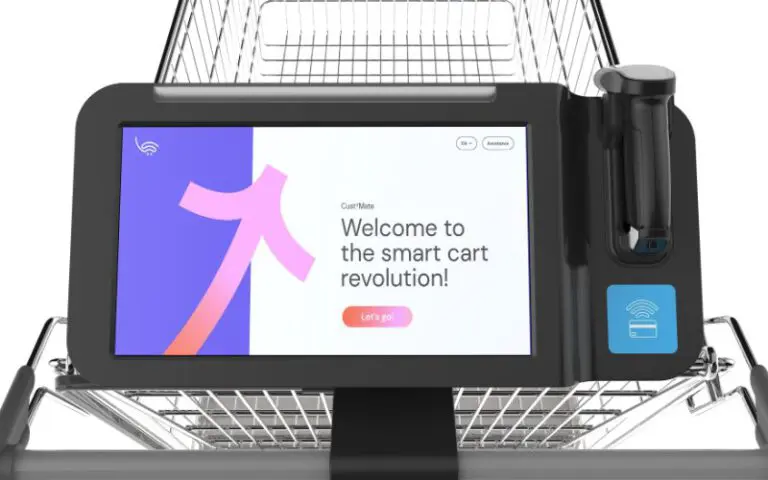
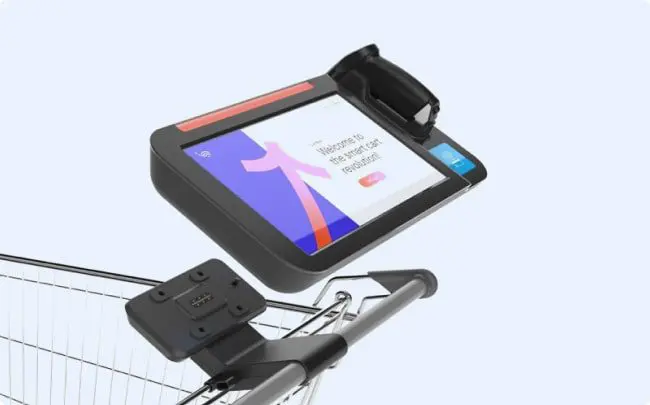
In the Seamless Store Checkout section, Coresight zooms in on smart carts that blend sensors, vision, touchscreens and AI. Here is how they describe what we do, and how we think about it internally.
From mass marketing to “me marketing”
In the interview, Yaniv explains how Cust2Mate uses AI to turn mass marketing into what he calls “me marketing” for each shopper. Our smart carts:
- Track activities and events in real time
- Understand what is in the basket
- Know where the shopper is in the store
- Link all of that to preferences and past behavior
That data feeds a closed loop that makes every interaction measurable, personal and directly tied to performance for both retailers and CPGs.
So instead of broadcasting the same offer to everyone, you can respond to what a specific shopper is doing right now.
Coresight calls out a few day-to-day examples.
- Scan pasta and sauce. The cart suggests Parmesan and garlic bread and can add all of it to the list with one tap.
- Scan a product. A coupon or tailored discount appears at the right moment.
- As a shopper walks past the beverage aisle, the cart can surface a snack offer that fits what is already in the basket.
- Mark your profile as plant based or gluten free. The entire experience shifts accordingly.
This is personalization that is rooted in behavior, context and inventory, not just in a CRM segment built last quarter.
What seamless checkout actually looks like in practice
“Seamless checkout” is one of those phrases that sounds simple until you try to deliver it.
In a real store it means balancing three demands at once:
- Shoppers want to get out quickly
They have already spent time making decisions. Waiting again at the end feels like a penalty. - Retailers need control and accuracy
Every item has to match the basket. Shrink has to be contained. High risk categories cannot be a blind spot. - Store teams need simplicity
If a solution adds more exceptions, new screens and complicated workflows, it will not survive the peak hours.
Smart carts attack all three at the same time.
According to the Coresight report, in our deployments:
- Shoppers scan as they go and pay directly on the cart
- The final checkout takes only a couple of minutes
- Shoppers rate the experience 4.3 out of 5 on average
- More than 60 percent of shoppers come back to use the carts regularly
From the retailer side, Coresight notes:
- Basket size on Cust2Mate smart carts is higher by up to 50 percent compared with standard checkout
- Loyal customers buy about five more items per trip
- That adds up to roughly a 15 percent uplift in basket value
- A typical smart cart trip carries about 43 items
This is what happens when you remove friction from checkout without losing control.
Smart carts as the meeting point of ops, media and shopper experience
One of the most important messages in the report is that smart carts are not only a front end tool.
Coresight positions them within the broader digitalization of the store:
- They are data sources for planning and assortment
- They are surfaces for in store retail media
- They are operational levers that affect staffing, lane planning and space
The numbers they highlight support that.
Coresight describes how one retailer using Cust2Mate smart carts:
- Has been able to remove up to four traditional checkout lanes relatively quickly
- Is now in the process of taking out most manned lanes and some SCOs as smart carts roll out at scale
That’s a structural change. It frees space, reduces staffing needs at static tills, and shifts the role of the front end from “where we endure queues” to “where we finish an already good experience.”
At the same time, the media side becomes more intelligent.
- Brands can see exactly which offers were shown, when, and in what context
- Retailers can connect promotions to actual engagements not just impressions
- Shoppers receive fewer irrelevant messages and more useful and specific prompts
It is one environment where operations, media and experience share the same live data.
You cannot talk about seamless checkout without talking about shrink
Any time you discuss faster checkout, the next question is obvious.
What about shrink and fraud?
Coresight is very clear that AI already plays a major role in loss reduction at self checkout. Computer vision and analytics monitor for mis-scanned items, suspicious patterns and outright theft, and can trigger interventions in real time.
In the Cust2Mate section, they call out the security layer in smart carts as a significant part of the story.
Every product that is scanned and added to a Cust2Mate smart cart is validated in real time, one by one. That:
- Catches most honest mistakes at the moment they happen
- Makes it much harder to manipulate baskets
- Reduces the gap between what the system thinks left the store and what actually left
The result is a checkout experience that feels light to the shopper, but is structurally tight for the retailer.
Fast and loose is easy.
Fast and accurate is where AI, sensors and smart flows have to work together.
Why this matters for the next wave of AI in retail
The last part of Coresight’s report looks at what comes next.
Three themes stand out:
- Agentic commerce
Digital agents and assistants that can search, compare, plan and even execute purchases on behalf of consumers. - Multi agent AI ecosystems
Different AI systems for forecasting, pricing, inventory, personalization and media that need to coordinate to be effective. - The fully digitalized store
Physical locations that act as connected data and media nodes, not black boxes at the edge of the network.
If those trends are correct, the question for retailers is not “should we use AI.” It is:
Where do we place AI so that we keep the relationship, the data and the value inside our own ecosystem.
This is where we see smart carts playing a strategic role.
- They keep the shopping journey anchored in the retailer’s environment.
- They connect operational data, media performance and shopper behavior in one flow.
- They turn each visit into a rich data stream that can feed forecasting, personalization and service.
In other words, smart carts are not only about checkout. They are one of the ways to future proof the store for an AI driven, agent heavy landscape.
Bringing it back to the store floor
Coresight’s report is a strong external validation of something we already see every day with our retail partners.
- AI in grocery is no longer a pilot playground.
- Seamless checkout is one of the critical use cases where AI delivers visible value.
- Smart carts are an effective way to connect faster checkout, better media and tighter control in one platform.
For us, the most important part of the coverage is not that Cust2Mate is mentioned. It is that the report treats smart carts as core infrastructure, alongside forecasting systems, shelf analytics and search.
If you are exploring where AI should live in your stores, our suggestion is simple:
Start where shoppers feel it, where operations see it, and where data can work across the whole business.
Start where you turn mass marketing into “me marketing” and queues into quick exits.