Mind the Gap: What 1,600 Consumers Just Told Us About the Future of Physical Retail
Something fundamental has shifted in the way people shop.
It did not happen overnight, and it did not happen in a store. It happened online, over years of frictionless checkouts, real-time price visibility, automatic promotions, and experiences that felt like they were built for you specifically. E-commerce did not just change where people buy things. It changed what people consider normal.
And consumers do not leave that standard at the door when they walk into a supermarket.
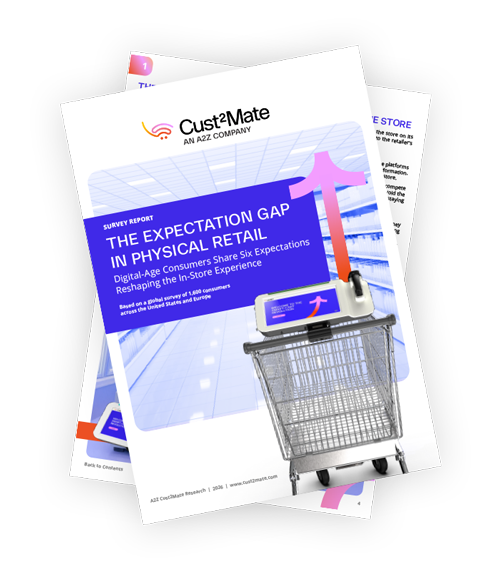
To understand how wide this expectation gap has become, we at A2Z Cust2Mate commissioned a survey of 1,600 digitally active consumers across the United States, Italy, and France.
We asked each respondent two things: how important a given experience is to them, and how well physical supermarkets actually deliver it. The difference between those two numbers is the gap. And across every dimension we measured, the gap is real, consistent, and costly.
Six Expectations. Six Gaps.
Our framework identifies six core expectations that today’s consumers carry into every store visit. The result is a clear picture of where physical retail is falling short and by how much.
1. Seamless
Walk into most supermarkets today and the friction starts almost immediately. Layouts built for merchandising rather than navigation, checkout lines that form no matter the time of day, loyalty apps that live separately from the shopping experience itself.
Sixty percent of consumers rated seamless checkout and easy navigation as highly important, and only 36% say stores deliver it. At 24 points, this is the widest gap we measured.
Most store operations were designed decades ago and the consumer’s journey was never really the organizing principle. Dynamic wayfinding and checkout that happens during the shop rather than all at once at the end address the two biggest pain points without changing what consumers actually value about being in a store.
2. Transparent
Online shopping has conditioned people to expect clarity at every step. Running totals update in real time, discounts apply without prompting, and nothing surprises them at checkout. Physical retail rarely works that way.
Sixty-eight percent of consumers rated real-time price visibility as highly important, yet only 48% say stores actually deliver it. That 20-point gap is the 2nd largest gap of all six expectations in our survey. And globally, 69% of consumers rank pricing transparency among their top in-store priorities, making it the highest-rated expectation in the study.
Pricing, promotions, and loyalty systems were built separately and still don’t talk to each other at the point of decision. The data to fix this already exists inside most retailers’ systems. The gap is a matter of connecting it and putting it where consumers can actually see it.
3. Rewarding
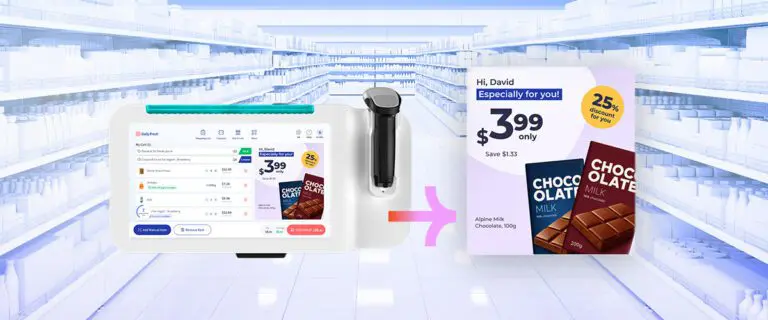
Online retail made discounts effortless, and consumers have carried that expectation into physical stores. Fifty percent rated automatic access to relevant promotions as highly important, yet only 31% say supermarkets deliver it reliably. That 19-point gap reflects how far the current experience falls short.
The problem is structural. Offers end up scattered across loyalty apps, paper coupons, and shelf tags, with the burden of tracking and redeeming them falling entirely on the consumer. A significant share goes unclaimed, and the retailer’s investment delivers far less than it should.
When a qualifying item enters the basket, the relevant offer should apply automatically, with no scanning or clipping required. That’s the standard consumers already expect, and meeting it is what builds lasting loyalty.
4. Guiding
Part of what makes online shopping comfortable is the availability of information at the moment of decision. Reviews, comparisons, ingredient details, alternatives — all of it is there before committing to anything. Physical stores have never really offered an equivalent.
Fifty-eight percent rated in-aisle guidance and product information as highly important, while only 46% say stores handle it well. That 12-point gap costs retailers real basket value on every trip.
Stores were designed to display products, not support decisions. Bringing reviews, ingredient information, and price comparisons into the aisle at the moment of choice gives consumers the confidence to explore rather than default to what they already know.
5. Continuous
More and more consumers arrive having already done meaningful work before they get there. Lists built at home, promotions browsed online, products researched in advance. The reasonable expectation is that the store picks up where that preparation left off.
Yet only 33% say retailers deliver on this, against 43% who rated it as highly important. That 10-point gap points to a disconnect most retailers haven’t fully reckoned with.
Online and in-store systems are typically built independently, so a consumer’s preferences and saved lists rarely travel with them through the door. When they do, the store stops feeling like a transaction that resets every time and starts feeling like the next chapter of an ongoing relationship.
6. Relevant
Consumers have grown accustomed to experiences that feel built for them specifically. Thirty-three percent now expect the in-store experience to reflect who they are, what’s in their cart, and where they are in the store. Only 26% say retailers deliver that today.
That 7-point gap is the smallest of the six, but it’s very likely the one that grows fastest from here.
Without knowing what’s in a consumer’s basket or where they are in the store, any attempt at personalization is essentially a broad guess. Real-time basket intelligence changes that. Retailers that develop this capability won’t just close the relevance gap. They’ll set the new standard everyone else is measured against.
What the Gap Actually Costs
Unmet expectations do not stay abstract. They show up directly in lost revenue, and our survey puts concrete numbers to what retailers are leaving on the table every single day.
Nearly a third of consumers have walked out of a store or abandoned a purchase entirely because of long checkout lines. The intent was there. The friction killed the sale. Close to half have chosen not to buy an item because shelf pricing or discount rules were unclear, and a similar proportion missed out on promotions they were already eligible for, not because the offer was not there, but because it was buried in a separate app, printed on a paper coupon, or simply never surfaced at the right moment. More than half could not find an item they intended to buy, resulting in an abandoned purchase or a switch to a competitor’s product.
Each of these outcomes is a direct consequence of one or more of the six gaps. Together they add up to a significant, recurring revenue drain that most retailers are not fully accounting for.
Closing the Gap Has a Measurable Upside
The same data that reveals the problem also points clearly to the opportunity. When stores get this right, consumers respond in ways that matter commercially.
Our findings show that an optimized in-store experience drives an 88% positive loyalty and preference signal. Half of consumers say they would return more frequently, more than a third would actively choose that grocer over a competitor, and a similar proportion would buy more items than originally planned.
Closing the expectation gap does not just protect existing revenue. It actively grows it, across trip frequency, basket size, and long-term retention.
Consumers Are Ready. Are Retailers?
One finding from the survey stands out above the rest. Consumer hesitation is no longer the obstacle.
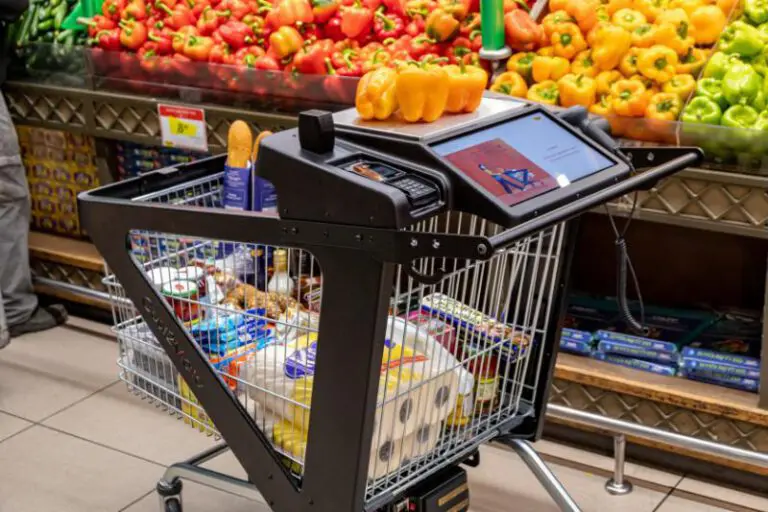
In fact, 52% of US consumers and 47% of European consumers explicitly stated they are highly likely to use a smart shopping cart that helps them track budgets in real time, locate products dynamically, apply coupons automatically, and bypass the traditional checkout line .
Consumers are not waiting to be convinced of the value. They have already internalized the standard. They are waiting for physical retail to meet it.
At Cust2Mate, our smart cart platform is built to close exactly this gap. By embedding real-time basket intelligence, personalized promotions, dynamic wayfinding, and in-cart checkout directly into the physical shopping experience, we give retailers the tools to meet consumers at the standard they already expect.
The expectation does not change depending on where you are shopping. The experience should.
Want the full picture behind the expectation gap?
Explore the complete Cust2Mate consumer survey and see what 1,600 shoppers expect from the next generation of physical retail.