
Smart shopping carts are taking the next step to making the experience for customers more seamless and allowing for upselling by retailers.
Cust2Mate’s smart cart technology was previously covered by RFID Journal in an article about how smart shopping carts automate payments in grocery stores. This article expands on that topic from Cust2Mate’s perspective and explains how on-cart payment, scan-and-go technology, AI, sensor fusion, and in-store data can help grocery retailers modernize the physical shopping experience.
Smart shopping cart payments allow grocery shoppers to scan items, view their basket, receive relevant offers, and pay directly from the cart without waiting in a traditional checkout line. For retailers, AI-enabled smart carts combine on-cart payment with sensors, barcode scanning, RFID, computer vision, location data, and real-time analytics to improve shopper experience, reduce checkout friction, support loss prevention, and create new in-store retail media opportunities. Smart cart payments can also support loss prevention by combining barcode scanning, weight validation, RFID for selected products, computer vision, and behavioral logic. Instead of relying only on a fixed self-checkout station, the cart can help validate what was added, removed, scanned, or paid for during the shopping journey. This is especially relevant as retailers continue to face rising theft and shrink concerns across physical retail.
Why Smart Cart Payments Matter More in 2026
Retailers are under pressure to improve the in-store experience while controlling labor costs, reducing friction, and protecting margins. AI is becoming central to that shift: NVIDIA’s 2026 State of AI in Retail and CPG survey reported that 91% of respondents are already using or assessing AI, while 90% plan to increase AI budgets in 2026. Deloitte’s 2026 Retail Industry Global Outlook also found that 67% of retail executives expect to have AI-driven personalization capabilities within the next year.
For grocery retailers, this makes the smart cart more than a checkout device. It becomes a connected in-store platform that can support faster payment, personalized promotions, shopper guidance, retail media, basket analytics, and better visibility into what happens inside the store.
Retailer technology company Cust2Mate has released the latest version of its Smart Shopping platform technology for connected shopping featuring carts that include linking customers to store content and enable self- payments. With the solution, shoppers can select goods from shelves, view content and recommendations related to those selections, and checkout.
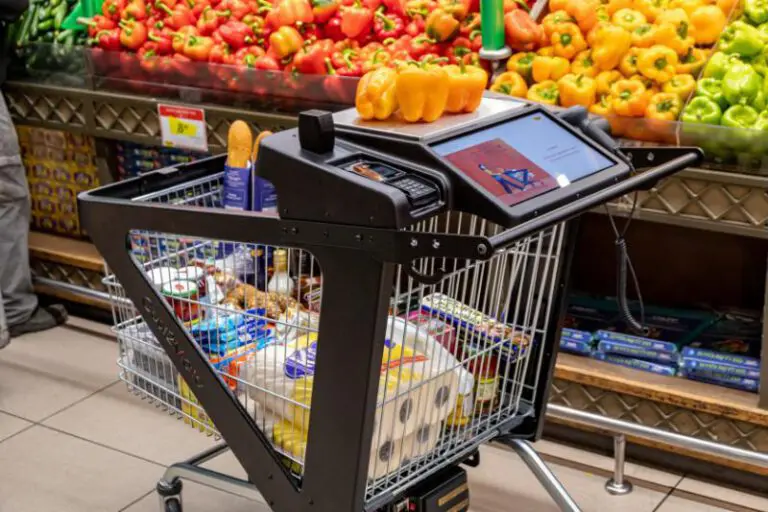
The Cust2Mate 3.0 smart cart platform centers around an attachable touch screen with built in sensors, processor and wireless connectivity. The unit has multiple features that identify products, as well as the location of the cart within the store.
In that way the attachable panel acts as a shopping assistant for individuals as they go about the store, explained Guy Mordoch, Cust2Mate’s CEO.
Early Adoption by Yochananof Grocery
Cust2Mate is an Israel-based technology company, with an office in the U.S., whose previous solution—the Smart Cart 2.5—is already deployed at supermarkets such as Yochananof.
One of the largest retailers in Israel, Yochananof already uses 1,300 smart carts in multiple stores. The Smart Cart 2.5 platform provides intelligence for the retailer and shopper, but must remain in the store.
The 3.0 version brings the same intelligence to brick-and-mortar stores, says Mordoch, but in the form of a detachable panel that fixes onto a store’s existing carts, and can be removed from them at the end of each shopping journey.
By making the panel mobile, the system now allows shoppers to take their cart out of stores to their cars once they have completed their payments and left the panel behind at a designated charging port.
The 3.0 panel comes along with a security scale that is installed on every cart which weighs products as they are placed in it. The panel itself includes a 13.3 inch screen, built in Wi-Fi connectivity, a UHF RFID reader, barcode scanner and AI computer vision technology camera.
Targeting Shoppers in Store
For retailers using the technology, the system will provide shoppers with an enhanced experience in their store. Using a cart with the panel attached to the handle, the panel’s Wi-Fi connectivity enables the system software to identify approximately where in the store the cart is. The retailer can view each cart’s status and location in real time or for analytics.
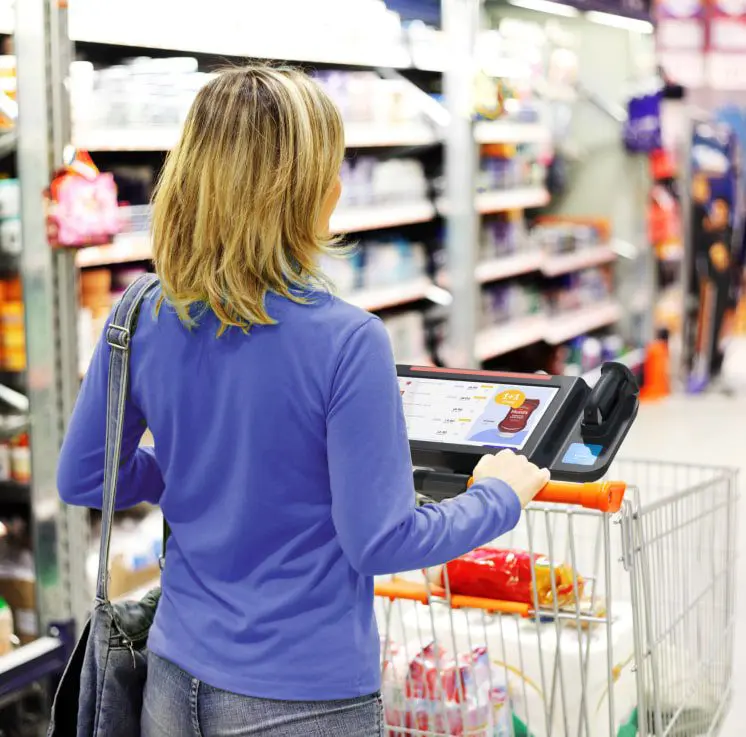
For the shopper, the screen on the panel provides content relevant to where they are and what products they are browsing through.
This offers the retailer the chance to communicate with the shopper and offer promotions in real time, such as a bag of chips in the snack aisle or a jar of salsa once the chips have been selected.
Tracking Purchases
Each time the shopper opts to buy a product, they scan its barcode with the panel’s built-in scanner, and place it in the cart.
If the item is high value the store will typically have applied a UHF RFID tag to it, encoded with a unique ID that matches the product serial number. That provides another layer of security to confirm the product being purchased is correct.
In fact, says Mordoch, “We have five layers of security,” which consist of the barcode scan, the product’s weight, an RFID tag read for high value items, as well as data from the AI camera, and, lastly, a software layer to determine whether there is any unexpected behavior.
Frictionless Shopping
When the shopper is finished, they can be anywhere in the store, and simply select a prompt to pay for their products. They then provide their payment information, complete the transaction and walk to the store’s exit.
At that door they remove the panel unit from the cart, place it on a recharging wall and continue to their car. There is no standing in line for a cashier.
“You just walk out with the cart all the way to your car,” Mordoch said.
Theft Protection
The system is designed to detect and address problems that could occur as well.
For instance, if a shopper pays for their goods, then places another item in their cart, the system identifies that action and can send an alert to sales managers.
With the use of Bluetooth technology, the system can even identify when the shopper’s panel approaches the door with their unpurchased item and trigger the cart’s wheels to lock, or the exit gate to close.
“We allow the retailer to configure how they want to deal with people that might be trying to steal,” Mordoch said. “Either they can stop the shopping journey in the middle and send somebody to deal with them, or they can just wait for the checkout.”
A third option is to wait to respond only if they are attempting to leave the store. “This is something which we can configure with the retailer,” he said.
Producing Panels in Volume
The company is now taking orders for the 3.0 solution. Retailers ordering the carts are located in the Middle East, North America, Asia-Pacific and Europe. Yochananof is ordering 1,300 more units to replace the existing smart carts, as well as about 2,000 additional panels to enable more do-it-yourself shopping.
“We are in the process of moving to mass production so we can actually fulfill all these orders,” Mordoch said.
There are multiple benefits to retailers adopting the solution, including larger sales due to upselling to customers while they are onsite, based on their location and shopping behavior.
“We provide a retail media platform that allows the retailer to bring more advertisement to the cart and to add the personalization and location-based capabilities,” said Mordoch.
Greater Sales
Based on upselling opportunities, Cust2Mate reports that the average filled-basket size is up to 60 percent higher than it is in the self-checkout or regular cashier line.
Another gain Mordoch points to is the ability boosts customer satisfaction and loyalty because of the more seamless purchasing experience. And the technology is promoted as reduce labor requirements.
The company has found that every 50 smart carts or panels installed in a store reduced the number of checkout lines by between two and three. By reducing cashier lines, stores have more real estate free for inventory on store shelves.
Shopping Connectivity
The technology is aimed at connecting the online or the “e-commerce” shopping experience with the brick-and-mortar stores.
Users can create a shopping list on a store’s site or in an app and once they are signed in at the store, using the cart’s panel, the technology will guide them to products they need.
Key Takeaways:
- Smart shopping cart leverages RFID, barcodes and camera intelligence as well as Wi-Fi for connectivity and location detection.
- With the technology, stores can provide a self-service experience for shoppers, while selling more products and gaining analytics about shopper behavior, according to Cust2Mate.
FAQ: Smart Shopping Cart Payments
What are smart shopping cart payments?
Smart shopping cart payments allow shoppers to scan products, manage their basket, and pay directly from the cart instead of waiting in a traditional checkout line.
How does on-cart payment work in grocery stores?
On-cart payment usually combines barcode scanning, a digital cart screen, payment software, product validation, and store connectivity. Shoppers add products to the cart, review their basket, complete payment, and continue without going through a cashier lane.
How are smart carts different from self-checkout?
Self-checkout happens at a fixed station at the end of the shopping trip. Smart carts move with the shopper throughout the store, allowing product scanning, recommendations, promotions, and payment during the shopping journey.
Can smart carts help reduce checkout lines?
Yes. Smart carts can reduce the need for traditional checkout lanes by enabling shoppers to complete payment directly from the cart. This can improve store flow and help retailers use checkout space more efficiently.
Can smart carts support loss prevention?
Yes. Smart carts can support loss prevention by combining barcode scanning, weight sensors, RFID, computer vision, and software rules to detect mismatches or unusual cart activity.
Why are smart shopping carts valuable for grocery retailers?
Smart shopping carts help retailers improve convenience, collect in-store shopper data, support personalized promotions, enable retail media, reduce checkout friction, and create a more connected physical store experience.